
Last updated: August 29, 2026. Some links on this page are affiliate links — if you sign up through one, we may earn a commission at no extra cost to you. It never changes what we recommend. See our Affiliate Disclosure.
Our verdict
The best-value all-in-one we’ve tested for solo operators. The free plan runs a real business — 2,000 contacts, unlimited emails, 0% transaction fees, and unlimited sub-accounts. The one catch worth knowing up front: you need your own domain before you can send a single email.
Try Systeme.io freeFree plan, no credit card required. Affiliate link — see our disclosure.
Systeme.io pros and cons
✓ What stood out
- Free plan runs a real business — 0% fees, unlimited emails
- Unlimited sub-accounts on every plan, free included
- $97 unlimited tier undercuts rivals’ entry pricing
- Funnel setup auto-generates the page structure
✗ What to watch
- Sending email requires a verified custom domain first
- Free plan caps automation at 1 rule / 1 workflow
- Smaller template and consultant ecosystem
- Editor’s section-panel UX takes adjustment
Systeme.io is an all-in-one platform for selling things online: sales funnels, email marketing, online courses, checkout, affiliate management, and website hosting under one login.
The pitch that gets attention is the price. The free plan is not a seven-day trial — it is permanently free, holds 2,000 contacts, sends unlimited emails, and takes 0% transaction fees. The top paid plan, with unlimited everything, costs $97/mo. Competitors charge that for their entry tier.
That combination invites an obvious question: what is the catch? This review is our attempt to answer it honestly, including the parts that count against it.
Who this is for — and who it isn’t
A good fit if you are a solo creator, coach, consultant, or small business selling courses, digital products, or services; you want one tool instead of five; and monthly cost is a real constraint rather than a rounding error.
A poor fit if you need to inject custom code into your funnels, want the largest possible template and consultant ecosystem to lean on, or need a dedicated best-in-class tool for one specific job rather than a capable all-rounder. Those are real gaps, and no price makes them go away.
Pricing
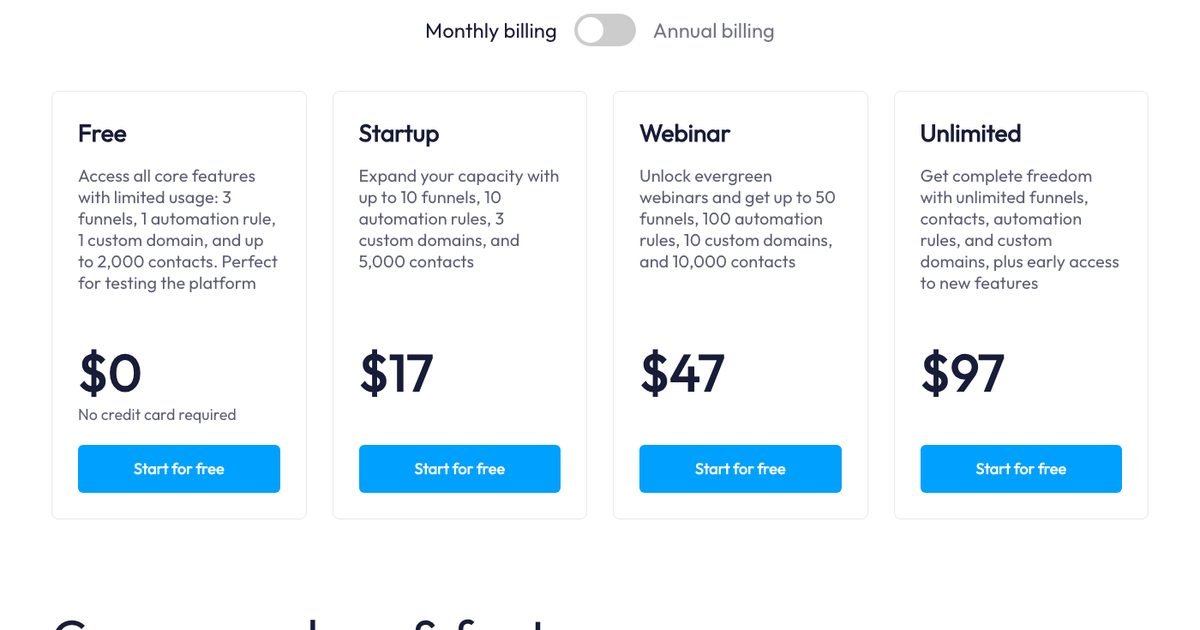
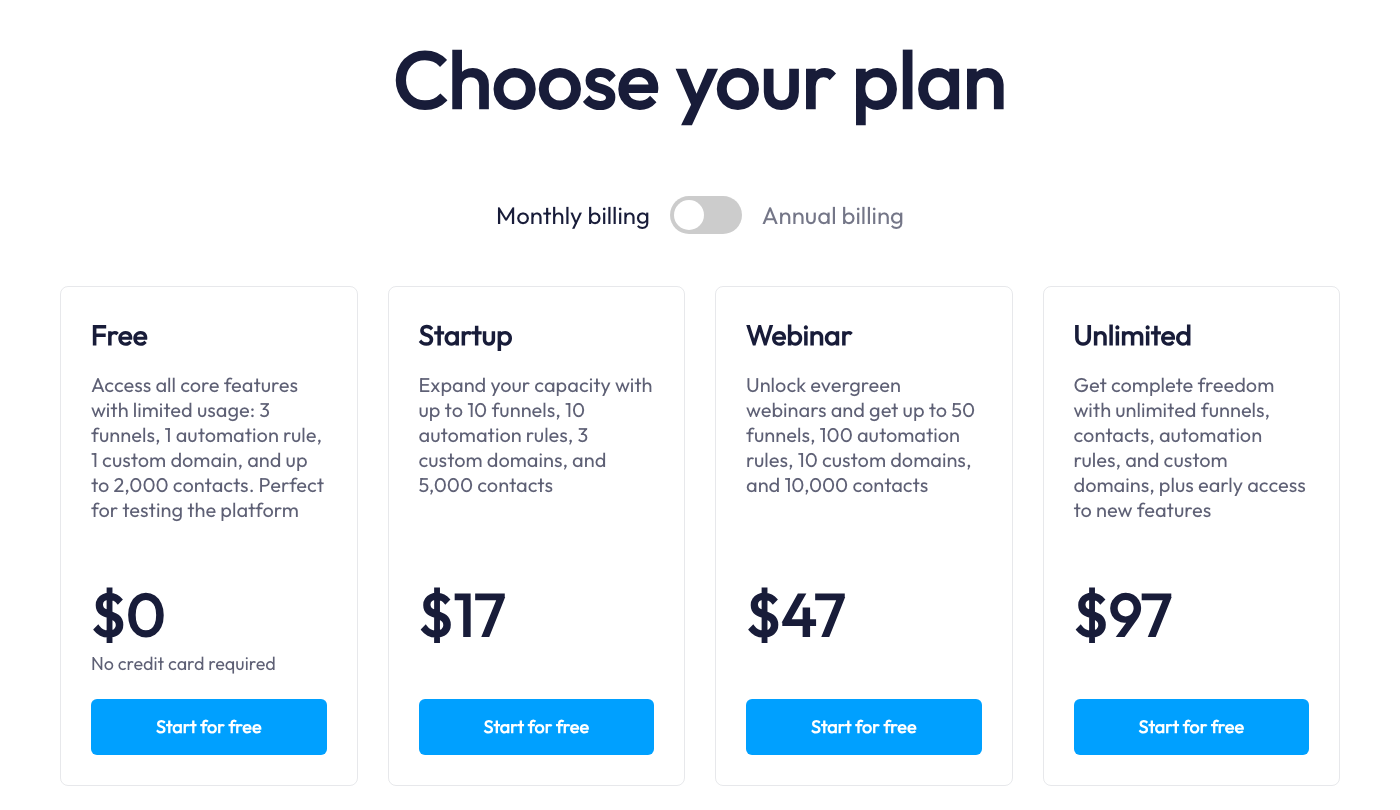
Four tiers. Annual billing gives two months free.
| Plan | Price | Contacts | Funnels | Custom domains |
|---|---|---|---|---|
| Free | $0 | 2,000 | 3 | 1 |
| Startup | $17/mo | 5,000 | 10 | 3 |
| Webinar | $47/mo | 10,000 | 50 | 10 |
| Unlimited | $97/mo | Unlimited | Unlimited | Unlimited |
Constant across every tier, including free: unlimited emails sent, unlimited file storage, and 0% transaction fees. Those three are unusual and worth checking against whatever you pay now — metered email and percentage-of-revenue fees are where all-in-one platforms usually make back the cheap headline price.
Create a free Systeme.io account — no card requiredAffiliate link — see our disclosure.
What you actually get
- Sales funnels — 15 steps on free, up to 300 on Webinar, unlimited on top. Includes 1-click upsells and order bumps at every tier.
- Email marketing — unlimited sends everywhere; campaign counts are what scale (1 on free, 10 on Startup, 100 on Webinar).
- Automation — 1 rule and 1 workflow on free, scaling to unlimited. This is the free plan’s tightest constraint in practice.
- Evergreen webinars — only from the $47 Webinar tier (10) and up. Not available on free or Startup.
- Websites, courses, CRM pipelines, A/B tests, deadline funnels — present at every tier with scaling limits.
- Unlimited sub-accounts on every plan, free included. Each is an isolated workspace with its own funnels, contacts, sequences, products, and domain, with one-click switching and two permission levels for invited team members or clients. For agencies this is the standout: no per-client subscription.
The honest downsides
- Smaller ecosystem. Fewer templates, fewer tutorials, fewer consultants who already know it. When you hit an edge case, you are more likely to be the first person asking.
- All-in-one means compromise by definition. A dedicated email platform will out-feature its email module. A dedicated course platform will out-feature its course module. You are trading peak capability for one login and one bill — a good trade for many people, but a trade.
- The free plan’s automation cap bites first. One automation rule and one workflow is enough to prove the concept and not much more. Expect this, not the contact limit, to be what pushes you to paid.
Hands-on notes
I went in expecting an all-in-one tool to feel like a step down from building a site properly. It didn’t, but it also wasn’t a straight upgrade — it traded one kind of friction for another. Here is exactly what that felt like, from an account I set up myself.
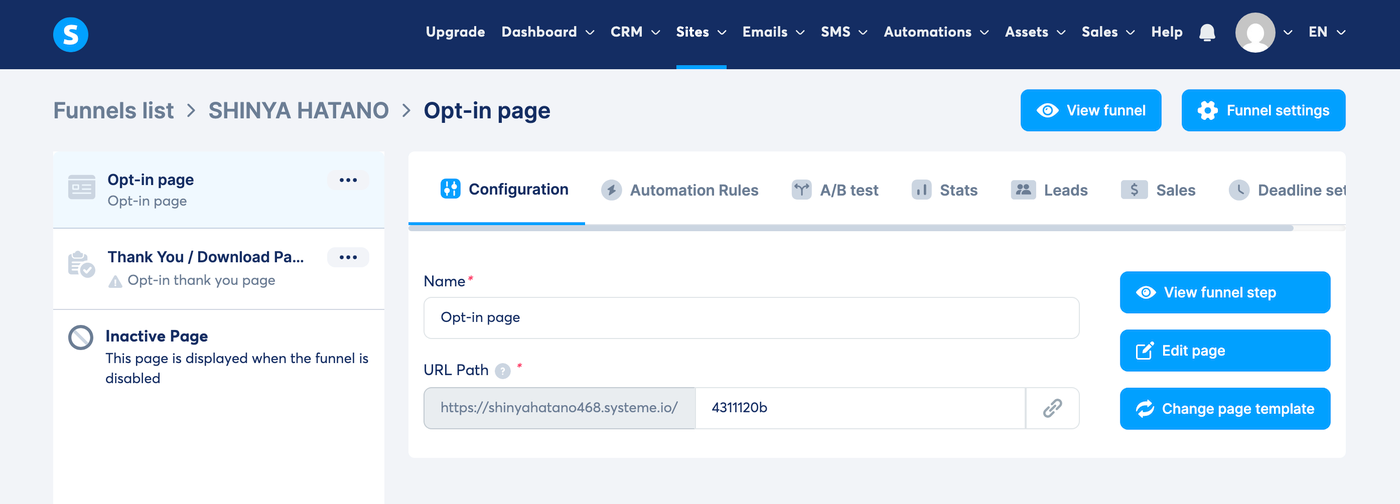
Setting up a funnel was faster than I expected. Picking “Build an audience” as the funnel goal auto-generated a two-step structure — an opt-in page and a thank-you page — with a template already attached. I didn’t have to build the skeleton myself, which is not how Shopify or WordPress start you off.
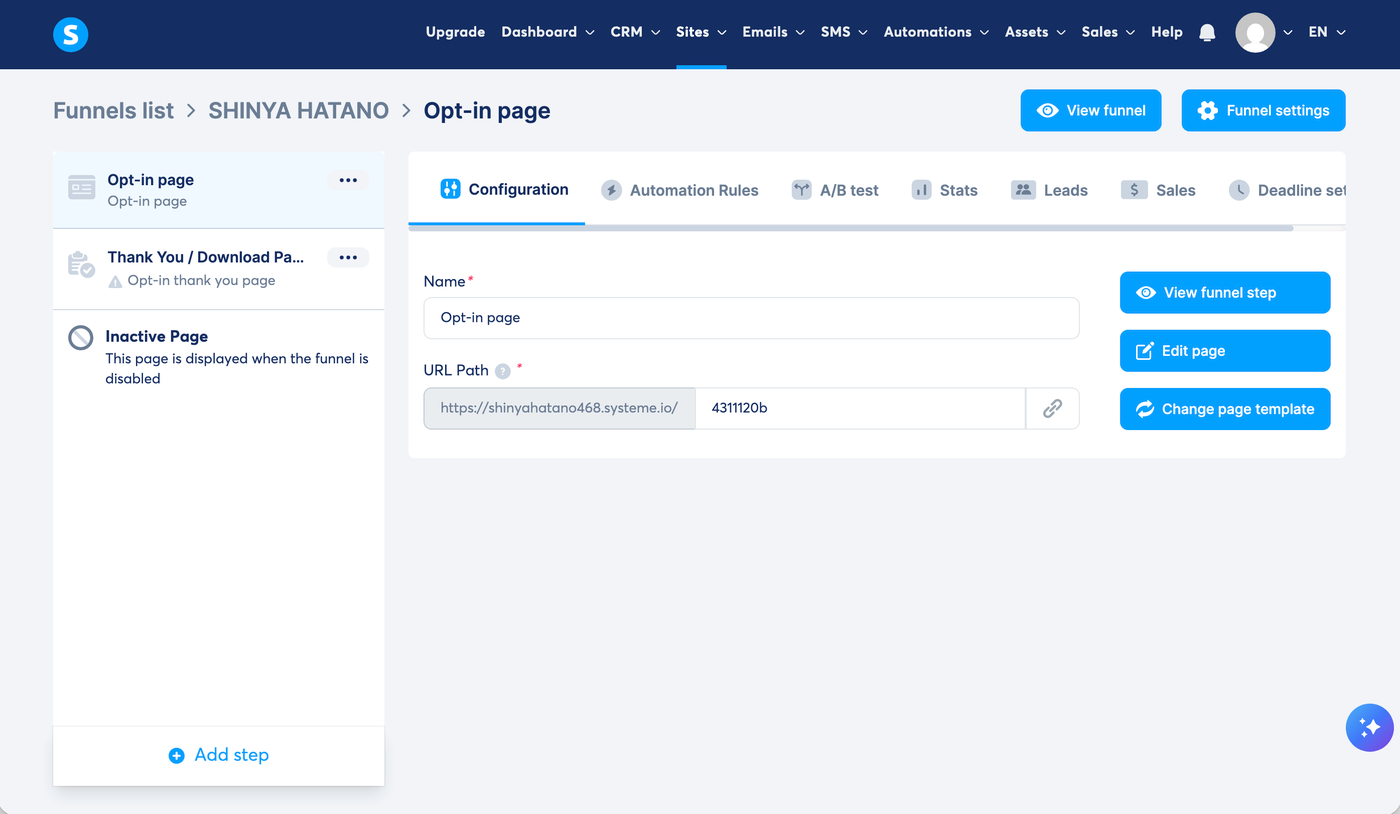
The page editor took a moment to get used to. Clicking a headline to edit the text opened a full section settings panel — padding, margin, background — instead of just a text toolbar. If you’re used to WordPress block editing, where clicking text mostly just lets you type, this feels like it’s showing you more than you asked for at first.
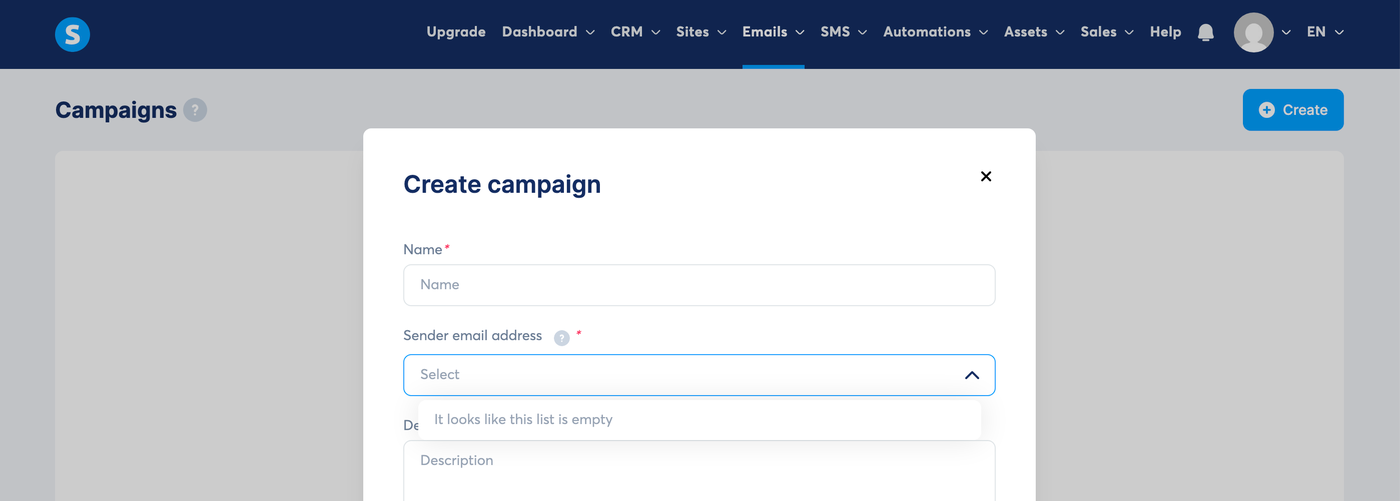
The real snag was email. I went to build a simple sequence and the sender address dropdown was empty — “it looks like this list is empty.” Turns out sending mail requires a verified domain connected under Settings > Emails first; there’s no way to send from a Gmail address or send a test with nothing configured. That’s a reasonable anti-spam guardrail, but it means the free plan’s “unlimited emails” claim comes with an unstated prerequisite: you need a domain before you can send a single one.
Sub-accounts were the pleasant surprise. I created one on the free plan with no approval step and no upsell prompt — it showed up instantly as a fully separate workspace with its own contacts, funnels, blogs, and courses counters, all at zero. For a plan that costs nothing, that’s more isolation than I expected.
Systeme.io’s help center confirms this too: “You can create an unlimited number of sub-accounts, even with a free plan” (help.systeme.io/article/4243). Its pricing table lists sub-accounts as Unlimited on every tier, including Free — so what we saw in our own account matches both pages.
Free Plan Starter Kit: create your account through our link (affiliate link), email the address you signed up with to hello@keptpicks.com, and we’ll send four one-page tools: a free-plan allocation sheet, a domain-verification checklist, a welcome-email template with fill-in prompts, and an upgrade-timing worksheet. Nothing to buy.
Frequently asked questions
Is Systeme.io legit?
Yes. It is a real company with transparent public pricing and a permanently free plan — not a trial. We tested funnels, email, and sub-accounts ourselves in a live account, and all of it worked as described on the pricing page.
Is Systeme.io worth it?
For solo operators and small businesses, yes. The free plan runs a real business with 0% transaction fees and unlimited emails, and the $97 top tier costs what competitors charge for their entry plan. It is a poor fit if you need custom code injection or the largest possible template ecosystem — see “Who this is for” above.
What are the most common Systeme.io complaints?
Based on our hands-on testing: the free plan’s automation cap (1 rule, 1 workflow) is tight, you cannot send any email until you verify a custom domain, and the ecosystem of templates and consultants is smaller than incumbents like ClickFunnels.
Is Systeme.io really free?
Yes. The free plan never expires, requires no credit card, and includes 2,000 contacts, 3 funnels, unlimited emails, and 0% transaction fees. The catch: you need a verified custom domain before you can send a single email, and automation is capped at 1 rule.
Does Systeme.io have hidden fees?
No revenue-share or transaction fees on any tier, including free — unusual for this category. You still pay the standard processing fees Stripe or PayPal charge, same as on any platform.
Verdict
Systeme.io is the strongest option we have found for solo operators who want an all-in-one platform without an all-in-one invoice. The unusual part is not the low price — plenty of tools are cheap — it is that the free tier is genuinely capable of running a small business, with no transaction fees and no email metering.
That also makes the decision cheap to test. You do not need our opinion or anyone else’s: build one funnel on the free plan and find out. If it holds, you have saved thousands a year. If it does not, you will know precisely which missing feature you actually needed, which is a far better basis for buying something more expensive.
Where it does not fit — custom code injection, or wanting the deepest ecosystem to lean on when you get stuck — it does not fit at any price, and we would point you at ClickFunnels instead.

I’ve been building and maintaining websites for about ten years. The first one is still online a decade later, and I still fix it when something breaks — which is how I learned that the interesting part of any platform is not the launch, it’s year three. I co-owned that site’s business, though I am not a co-owner today; the business itself has since closed. Separately, I have also run an online store on Shopify, until the fees pushed me onto a different payment system. Today I choose the host, the theme and write the plugins that run this site, and I pay for the tools I test out of my own pocket. More on the About page, and exactly what we did and did not test in how we test.
Pricing and plan limits verified against systeme.io’s public pricing page on August 29, 2026. Vendors change terms without notice — check before you buy, and tell us if you find something out of date.
Try it yourself: Systeme.io’s free plan is permanent, not a trial — 3 funnels, 2,000 contacts, unlimited emails, 0% transaction fees, and unlimited sub-accounts. Start on the free plan and find out in a weekend whether it covers what you need. (Affiliate link — see our disclosure.)